
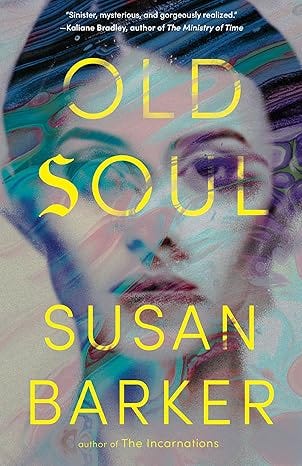
Old Soul
Susan Barker, G.P. Putnam’s Sons, January 28, 2025

When you’re nineteen, it can happen that, without planning or premeditation, an afternoon chat with a friend becomes an all-night affair. An impromptu dinner turns into a meandering nighttime walk in which the conversation is pitched at the thrilling downward grade of a sled run. Self-disclosure starts as a dare and becomes a kind of endless-seeming dance. You experience the rush of discovering your secret self as you reveal it to another person.
College can be great for this kind of thing, and in the instance I’m remembering, the magic of this particular encounter was sealed by a bizarre interlude: While my friend and I were talking, we were interrupted by the sudden appearance of the entire men’s hockey team, all of them bare-assed naked. Apparently on some kind of ritual streaking event, the team stopped for several moments to idle next to the tree behind which my friend and I were sitting. Without seeming to notice us, they stretched and slapped their bellies and caught their breath, exhaling steam into the night air. Somebody leapt onto a bench so he could piss off it; someone else giggled as he smacked as many butt-cheeks as he could before his teammates shooed him away. It was as if we had come upon a herd of reindeer grazing in the suburbs—we felt lucky to have stumbled into this moment of unexpected wonder; we were a little worried we might get trampled. Eventually the men picked up on some wordless signal and ran off again, leaving me and my friend speechless: The moment was both absurd and a strangely apt metaphor for the way affection—puppyish and graceless and vulnerable—had suddenly materialized between the two of us.
We kept walking. Eventually, we found ourselves lying down in the furrows of a dirt field, looking at the stars and talking about death. After I offered some windy pontification about consciousness and the eternal soul, my friend shrugged and answered, “I don’t know. I don’t mind dying. Just the idea of laying down my burdens one day, not carrying everything I carry. I’m okay with it.”
It was a night of surprises. I remember looking at this person—a kind, intelligent, funny friend who was, I had recently realized, quite beautiful—and thinking, Well I’m not going to date YOU!
My friend’s statement was not so much a turn-off as it scared the bejesus out of me. At that time, to my mind, romance was something you did chiefly as a way of hiding from your own mortality. Which, I understand now, is another way of saying “hiding from yourself.”
If you gave a few billion dollars to that dumb kid lying in a field, incapable of seeing what was right in front of him, he’d fit right in with the tech bros pumping the national GDPs of a dozen or so island nations into the prospect of living forever. There is a fairly broad philosophical consensus that death is, you know, a bummer, so it makes sense that after a lifetime of getting everything one wants, a person might think that mortality was, like winter coats, the kind of hassle someone might simply buy their way out of.
The premise of Old Soul, Susan Barker’s chic Gothic horror novel, is that a person who elects never to die is pretty much a monster by definition. Barker’s novel is itself a kind of monstrosity—that unnatural patchwork of incongruous parts granted a questionable coherence some call a novel-in-stories. The book’s titular “old soul”—she goes by many names—isn’t so much a main character as a recurrent peripheral presence. Old Soul is constructed as a series of testimonies of imperfectly remembered encounters with a mysterious woman who might have caused the untimely, unpleasant deaths of numerous people across generations. The woman is a cipher—she is slight, smart, polylingual, gamine, ageless, opinionated, sexually dynamic. Chapter by chapter, the reader is granted tantalizing clues into this woman’s methods and motivations. Somehow, this woman never ages past her forties, despite her having appeared to successive generations for centuries. In an evocative and poetic flourish, she seems to take pictures of each of her victims before they meet their unhappy ends—although in previous centuries, this photograph becomes a hand-drawn sketch.
The story begins when two strangers joined by happenstance—they happen to have just missed the same flight—realize over a drink that they each have had loved ones die under strange circumstances, having succumbed to identical delusions not long after being courted by an eccentric European photographer. Primed by this coincidence, one of these characters attempts to identify this photographer, and throughout his subsequent interviews the coincidences accrue like cracks over the surface of a dark, frozen lake. The trick in a book like this—a mystery without a main character—is information management, and Old Soul balances its revelations and its coyness expertly. Readers may be Barker’s quarry, but, unlike her character’s victims, they’re not likely to feel ill-used. Barker has a way of distributing the bread crumbs in such a way to keep us happy on the hunt, and when the long-awaited lore drop finally lands, it is—to my ear—satisfyingly goofy. Crafting a mythological MacGuffin in a supernatural yarn like this is less about being credible or even internally coherent than it is about being creative and committing to the bit. The engine of ill-gotten immortality in Old Soul involves some handwaving about Venusian demons and Luciferian cults, but it’s delivered with enough authority and panache to keep me riding along. Five seasons and nine years into Stranger Things, Lord knows I’ve surrendered my attention for homebrewed mythologies a lot more hairbrained than this one.
A bigger question, to my mind, involves the character of the woman herself. If Old Soul isn’t perfect—whatever that would mean—Barker manages to make canny use of its deficiencies. The woman we’re tracking is intriguing as scenery and as a plot device, but her psychology feels too shallow to withstand much scrutiny. Even when she’s falling in love, the woman is more mythic than personal, which might be another way of saying she’s full of shit. We are told that the character who eventually falls in love with her—a monastic and brilliant sculptor in the American Southwest—shares long, digressive conversations about art with the woman, but the reader, crucially, doesn’t get to hear these first-hand. At one point, the woman boasts that she is an artist of longevity and that her life is her canvas—it’s a good line, but what does it mean, exactly? After years of distance, the sculptor reflects that her paramour was less a god than a slave, more pawn than queen. The evil that sacrifices everything at the altar of immortality is banal by design. Part of what makes this ageless author of atrocities so frightening is that, at the end of the day, she’s kind of boring.
Allowing the totemic mystery woman to remain a little dim, a little pathetic, is perhaps the book’s greatest triumph. Old Soul gestures at times toward linking the extravagance of art with the decadence of deathlessness, but Barker mostly leaves this old trope of the demonic aesthete underdeveloped. The novel is not a philosophical disquisition on life, death, and art—it’s a bad dream, compelling in part for its hallucinatory brevity. Fittingly, the book’s best and most brutal sections are its ending—where it requires the woman to live, as it were, with the consequences of her decisions—and a brief epilogue that suggests believing you can outwit death is more likely to make you a tragic oaf than an evil genius. Perhaps the best compliment I can pay to Old Soul is to say that I’m glad I read it, and I’m glad it ended. May it ever be thus.