
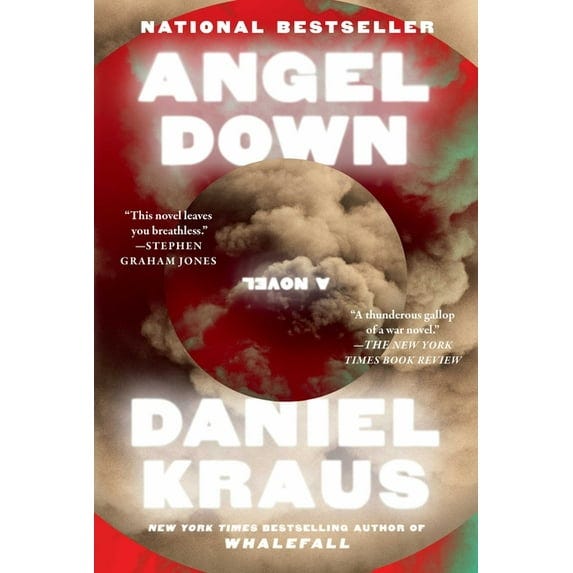
Angel Down
Daniel Kraus, Atria Books, July 29, 2025

At the Christian liberal arts college where I got my BA, I took a two-year Great Books course in which our stated goal was to track the singular, multifarious “great conversation” of ideas that spans texts, centuries, and civilizations. Whether such a conversation actually exists when we’re not squinting through the narrow aperture of our own cultural prejudices is rightly up for debate, and whether reifying such a chimera through concepts like the canon or the monomyth does more harm than good is a discussion worth having, but I’m still grateful for the course because it led to many lively small-c conversations that turned out to be—in the context of my own life, if not the grand arc of history—memorable.
After one such class, I remember a friend of mine—a smart, irreverent, young atheist—left the room muttering and shaking her head.
“How long,” she yelled, when we’d left the professor’s earshot, “are we gonna keep talking about Jesus?!”
I love this memory because of how it captures a very human response to any ponderous discussion about the “universal human condition.” A conversation is about ideas, yes, but it’s also a dramatization of a relationship, and from time to time relationships get toxic. Sometimes when you’re trapped in a millenia-old debate that’s stuck on the same metaphors, the same archetypes, and the same dialectical polarities, the only thing to do is to crack a window and climb out of it. Sometimes you want a new conversation.
One of the fun things about genre literature is that—with its speculative histories set in galaxies far, far away, its private languages of generic symbols and signifiers, its tropes that bend the arc of history to their own gravitational logic of ancient space monsters, journeying heroes, and happily ever afters—it makes a new conversation seem possible. It serves up not just escape, but an entire mechanism of escape, an escape-ism where we might cultivate stories as alternatives to the world, rather than amplifications of it. Whether or not genre literature ever really provides this clean escape is an open question,1 but it’s safe to say a fair number of people are drawn to political melodramas about alien races set thousands of years in the future or improbable, class-hopping romances in Regency England because the settings in which these stories take place are emphatically not here.
Angel Down, Daniel Kraus’s WWI-era supernatural thriller, is written to engage—and perhaps enervate—folks who are tired of talking about Jesus. At least, they’re tired of here. Or maybe it’s for folks who are just tired generally—“drunk with fatigue,” as Wilfred Owen memorably put it—folks for whom history has begun to feel like a forced march through an endless, blasted-out no-man’s land. Kraus’s novel begins mid-sentence in the moments before an artillery shell narrowly misses Bagger, the book’s protagonist, and it limps on, blood-shod, through 280-odd pages of grim, pointless violence, nary a period in sight. Each of its paragraphs begin, thuddingly, with the word “and”—by the second chapter they feel as concussive and metronomic as mortar fire. Fittingly, Kraus’s prose style is both dazzling and dizzying. An early chapter begins,
“and Reis paces the slime in smart spiderleg, indifferent to the day’s necrosis, while just past the vomiting chaplain, the poor devils of Company P force themselves to stay upright on their blisters, awaiting Reis’s order, knees singing, brainpans percussive, eyelids blue flame, radiating loathing for the five flunkies, all of it rancid gravy down Bagger’s throat,
and Reis looks like he could pace like this all day…”
This prose is purple, but luridly, necrotically so. Kraus means to conjure a world of moral rot and sensory excess, and he does so with a novel-length single sentence that appears to be aiming for a warning that it might cause epileptic fits. This approach works intellectually—it’s a kind of IMAX, surround-sound literary Modernism, recalling Denis Johnson or Stephen Wright—but it’s also a poetic way to capture the sensory overload of a war that was bigger, louder, and bloodier than any that came before it. Kraus’s stylistic overkill “shows” even when it’s telling, and his subject is the slog of war: the experience of living through a period in which humanity’s ability to kill each other at scale suddenly advanced beyond our capacity to understand or endure.
If the style and the setting of Angel Down are designed to overwhelm, its plot is mercifully simple. Cyril Bagger, a con man who enlisted to avoid a prison sentence, is one of P Company’s five most wretched soldiers, along with an oafish, syphilitic bully, a black market dealer who carves valuables from the corpses of his fellow soldiers to sell to the enemy, a puppyish fourteen-year-old who lied about his age to escape his impoverished upbringing, and the shell-shocked sole survivor of a massacred regiment of black Americans. This litter of runts is dispatched to find and “help” (read: euthanize) a mysterious, unseen soldier whose unceasing cries of pain are sapping the terminally depleted morale of everyone who hears him.
When the group finds their quarry, however, it turns out to be not an American soldier (a “doughboy”) but an injured angel, a radiant being of impossible beauty, whom Bagger speculates the Germans inadvertently felled with their Kaiser Wilhelm Geschütz, “a barge-sized weapon with a three-story barrel that months ago pummeled Paris with two-hundred-plus-pound shells from seventy-five fucking miles away, a distance so vast the Squareheads had to factor Earth’s curvature in to their trajectory math, or so rumor had it…”
From here, the familiar war story becomes an intriguing genre mashup. We quickly learn that each member of the rescue mission sees their own version of the angel, and each has his own (bad) idea of what they should do with it. For a moment, the narrative, like the angel trapped in concertina wire, seems ensnared by its sheer uncanniness, and Kraus’s novel feels a little like “A Very Old Man with Enormous Wings” filmed by Michael Bay. But as the soldiers’ bad ideas beget worse ones, the story’s plot reawakens, and Bagger’s mission—doomed though it may be—quickly becomes an existential parable: life as an impossibly precious miracle, dropped smack-dab in the middle of hell.
As the plot piles the ordeals on Bagger, the novel’s core of recurrent motifs, allusions, and metaphors achieves a kind of planetary density. Page by page, the book’s power deepens like a coastal shelf. Bit characters take on credible symbolic weight. A throwaway game of rock-paper-scissors is, in retrospect, granted totemic resonance. When the third-act features a walk-on cameo by Satan, it feels both startling and inevitable—Kraus’s portrait of Old Scratch is both a fresh take and lifted right out of the Book of Job, sometimes called the oldest book of the Bible. All the while, the more Bagger struggles, the tighter he’s caught in the web of history. As Bagger’s memories braid with the threads of history and myth, it becomes clear that the nightmarish new story he’s found himself in is actually the oldest story in the world. Accordingly, when he’s granted a mystic vision of history, it’s not a slaughter bench he sees, but a gargantuan machine that grinds stories into mortar shells it blasts with titanic, terrifying violence. It might be the war to end all wars Bagger fights in, Kraus suggests, but that doesn’t mean it has a beginning or an end.
And yet, all this makes Angel Down sound like more of a, um, downer than it actually is. Bagger is a plucky and wry, a believable and likeable character, and the book ultimately offers him a kind of redemption. What it won’t offer him is an escape. Neither, incidentally, will it offer one to the reader. The more the reader sees of the angel and her incredible powers, the less Angel Down feels like period escapism and the more it becomes a tale planted firmly in 2025, a time when astonishing new technology—a “wonder weapon” is what one army commander calls the angel when he sees her—has some people wondering whether the old virtues like fairness, equality, or human compassion matter any more. As another ancient wisdom book puts it, “there is nothing new under the sun.” No new sentences, no new conversations. Here is all we ever get. For all its sound and fury, Angel Down reminds us we’re lucky to have it.
Lincoln Michael’s 2025 Metallic Realms is a very fine and very fun recent novel about the illusory escapist promises of science fiction.