
Shroud
Adrian Tchaikovsky, Tor, February 27, 2025 (UK)

Shroud
Adrian Tchaikovsky, Tor, February 27, 2025 (UK)
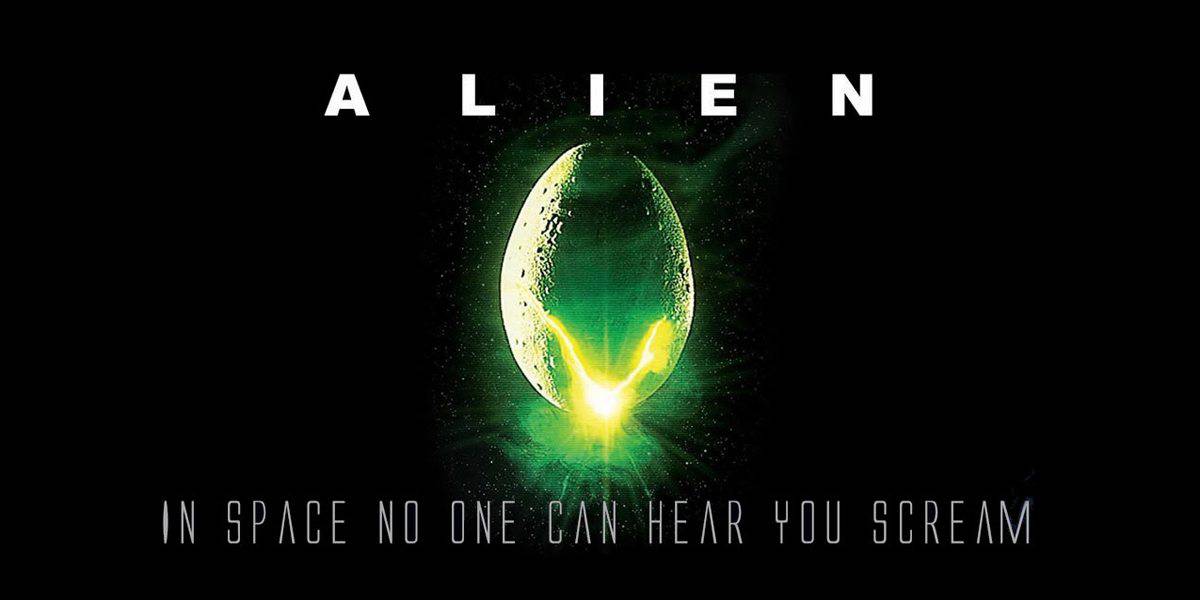
For my money, a horror fan still can’t beat the Alien series for pure terror. If you haven’t seen Alien,1 its plot is that a terrifying space monster has evolved for the express purpose of doing gross and painful murders, and of course the monster is set loose on a spaceship where it kills a bunch of workaday space jobbers one-by-one, because capitalism. Which, fine, sure—scary stuff. But no scarier than, say, Freddy Krueger or Jason or Jaws or Jeepers Creepers. What makes the Alien series more than a supercut of sublime jump scares2—what elevates it to an existential gut punch whose scenes replay in your mind as you stare at the ceiling in the wee hours—is not its plot but its premise. Namely, that the universe itself is a terrifying space monster custom-built to chew you to bits with its nightmarish metal horse teeth. If you don’t believe me, cue up the scene where the disembodied head of Bilbo Baggins waxes poetic about the eponymous alien’s evolutionary perfection. It’s at least as chilling as the chest cavity-bursting violence that surrounds it. Do some Googling of H.R. Giger’s signature Xenomorph art—all nightmare phalluses and vaginas dentata, an entire ghastly corpus designed around the question, “What if the human reproductive system were designed to torture you to death?” I’ve heard folks describe the Alien series as “Lovecraftian,” but Lovecraftian horror imagines the universe as a clock wound to an ancient, unknowable logic so alien to human subjectivity that to even glimpse its inner workings is to go insane. The logic at the heart of the Alien series is horrifying precisely because it’s so comprehensible. “Survival of the fittest.” That’s it. The music of the cosmos is just a card game of War that squishy humans, with their skimpy underwear and pet cats, are destined to lose. Watching the best of the Alien series3 is like getting to the end of AP Bio and seeing the last exam question is 1) Does God hate you? a) yes b) hell, yes or c) Actually, he doesn’t think about you at all?
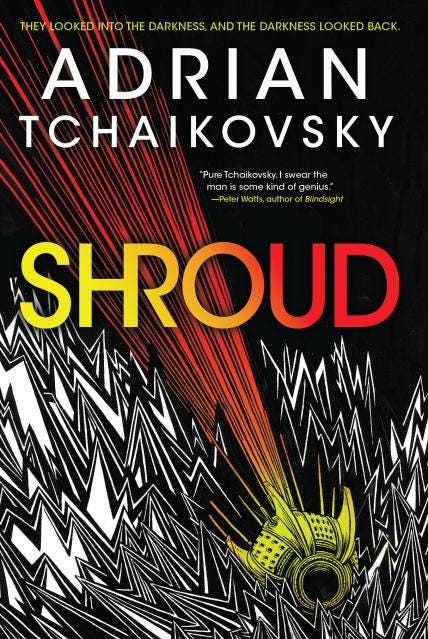
Adrian Tchaikovsky’s 2025 science fiction novel Shroud begins as a slick horror tale in the key of Alien. In fact, the two stories begin more or less identically, with an artificially intelligent spaceship rousting its crew of clock-punching schlubs from hibernation to investigate the possibility of making a quick buck. Both the Nostromo—the spaceship in Alien—and the Garveneer—the vessel in Shroud—are in the business of interstellar resource acquisition. The Nostromo is a mining vessel whose homeward trip is interrupted by a distress signal; the Garveneer is one of a few hundred spaceships owned by a “Megasocial Opportunity Exploitation Concern” (called a “corporation” at an earlier point in history, we are told) constantly scouring space for extractable resources. In both stories, the crews end up exploring a strange moon whose dark environs host hostile, creepy-crawly types—the infamous xenomorph, in the case of Alien; in Shroud, a race of giant rolly pollies who reconfigure their exoskeletons into machinery and share a faltering hive mind.
More crucially, both stories use their monochromatic settings to make a (not particularly) subtextual argument against metastatic capitalism. The universes of Alien and Shroud are ones where the unfettered pursuit of economic growth has crowded out almost all other human pursuits. There are no Shakespeare-quoting space pirates or gelatinous blob operas here. Culture outside work is more or less non-existent. Galactic boundlessness has been bought with strict and impassable imaginative borders.4 Despite the wealth of world-building detail, each fictional universe is distinguished by a grim paucity of imagination at its center—the only force in either story supposed to generate enough firepower to blast the human race past escape velocity is galloping, growth-at-all-costs profitmongering. In both works, civilization is ruled by transnational corporate conglomerates that aspire to the same ethos attributed to Alien’s xenomorph: “surviv[al], unclouded by conscience, remorse, or delusions of morality.” The bleak fictional worlds, in other words, get the monsters they deserve.
Except that’s not what happens in Shroud. The horror vibes in Tchaikovsky’s novel are real—his setting might not be as nightmarish as H.R. Giger’s baroquely bleak landscapes and demon physiologies, but much of the creative energy of the novel’s beginning is spent evoking the inky atmosphere (“anoxic, volatile, thick as soup”) that blots out all light on Shroud, a mineral-rich moon, and has steered its unseeing, insectoid fauna into modes of perception based in electro-magnetism and echolocation.5 But the book takes a turn when a catastrophic mechanical failure strands two crewmembers on Shroud’s lightless surface. Shroud’s second act is something between a travelogue and a disaster film. The stranded crewmembers must blindly pilot the spacefaring equivalent of a rickety liferaft through several distinct, creature-rich ecosystems to the other side of the dark moon, where they theorize they might be able to signal for help. Thankfully, Shroud lacks the self-congratulatory sheen of competence porn like Gravity or The Martian. The women’s journey is snakebit from the beginning, and any progress they make is halting and partial. Interestingly, they don’t work alone—the women attract not just the attention, but the assistance of Shroud’s dominant lifeforms, the aforementioned rolly pollies, whom the narrator nicknames “the Shrouded.” As Tchaikovsky grants these adaptive, xenomorphic beasties motives more complex than those of a typical haunted house employee, the book itself begins to transform—what appeared to be a competent, but derivative Alien homage evolves into something more wide-eyed and wondrous. Gradually, the reader’s pent-up sense of horror and revulsion is transferred from the unseeing, uncanny monsters of Shroud to the faceless and myopic corporate lackeys back home, for whom decimating an alien population or forcibly hibernating its own employees is all part of a balanced spreadsheet.
In fact, the Shrouded, whose first-person subjectivity and evolutionary history take up more real estate as the book goes on, are arguably more compelling than the novel’s human narrator. Juna, the shipwrecked crewmember who narrates Shroud, is essentially the Garveneer’s human resources rep. She is a generalist tasked with acting as a helpmate and go-between for her crew of scientific specialists. But Juna’s expertise is less human psychology than it is the logical endpoint of A.I. prompt engineering—her job is to use her skills as a communicator to coax as much efficiency and cooperation from her team as possible. And since citizens in the novel’s spacefaring society are valued exclusively for their utility—a person whose vocational expertise is not deemed relevant to a current mission is warehoused indefinitely in a state of suspended animation—pretty much all eccentricity and non-mission specific desire has been stripped away from Juna’s character or made vestigial. In other words, Juna is human, but it’s not always clear she is what the reader would call a person. This makes her the perfect foil for the Shrouded, who are NOT human, but who manage to earn the reader’s—or at least this reader’s—curiosity, admiration, and loyalty.
By the end of the novel, Shroud succeeds by becoming the anti-Alien. Tchaikovsky employs a few formal hacks to pull off the impossible task of evoking an alien subjectivity in words—among his neatest tricks is to force the Shrouded to reckon with the conundrum of human intelligence in a series of extended monologues:
I cannot feel you, though, I can feel the effects of your actions. On the ground I find the precise boundaries of your perception, just as if you were a beast I was hunting, save that you mark those boundaries with lines of death. Even though you dig in the earth, you do not pay attention to what goes on beneath you.
To the Shrouded—whose thoughts scurry into the material world as physical beings, and who can rejigger their protean exoskeletons into complex, living machines—human consciousness, with its dependence on vast, inert mechanical scaffolding and its tendency to produce as much trash as progress, is a vexing, ghostly presence-in-absence. The aliens’ heroic, ingenious attempts to interact with aloof, bottom line-obsessed human beings might lack a Spielberg-ian sentimentality, but they still manage to make the paranoid, existential hand-wringing of an H.P. Lovecraft look like kids’ stuff. “Get out of your head!” Shroud says to the grimdark pseudosophistication of Alien. “Just because it doesn’t look like you doesn’t mean it’s gonna grind you into paste! Go outside and touch grass!”6 Tchaikovsky’s accomplishment is to make his readers feel depressed and abashed about the human race while still feeling hopeful and curious about the universe. In his vision, life is at least as miraculous as it is hostile or indifferent, and evolution grants it the capacity to endlessly, iteratively reflect and self-correct. Humans are the ones living behind the shroud. In our rush to map and exploit, our capacious, hungry vision apprehends everything in the universe except ourselves.
First off, my condolences: it’s a real bummer of a time to be emerging from a 46-year coma.
For the record, I would put the recent Alien: Earth series pretty high up there on the list of great Alien media.
In a sobering detail, when the crewmembers in Shroud are sexually intimate, the employee who ranks lower on the corporate ladder calls the practice “buffing;” the higher-ranking partner calls it “resourcing.”
“The world roared,” Shroud begins, and it’s the hum of radio activity that draws the attention of the Garveneer. Purposeful or no, it’s a neat inversion that, on Shroud, life has evolved so that everyone can hear you scream.
Or, you know, touch the viscous, opaque atmosphere of the nearest life-supporting moon.
This article comes at the perfect time, you've really captured the Alien series' deep dread. Isn't it the cosmic indiference of such perfectly evolved algorithms that's the true horror, though?